EN

Why Choose ODM Service for Custom Cable Assembly in Wireless Base Station Projects
Deploying modern telecommunications infrastructure requires a delicate balance of rapid technological adaptation, strict regulatory compliance, and rigorous cost management. As mobile network operators worldwide transition toward denser 5G deployments, advanced cloud-RAN architectures, and multi-band distributed antenna systems (DAS), wireless base station projects face unprecedented engineering and logistical challenges. Designing internal and external interconnects that survive severe weather, high mechanical vibration, and high-frequency signal attenuation is a major undertaking for equipment manufacturers. Rather than relying solely on standard OEM contract manufacturing, telecom brands increasingly leverage a specialized Original Design Manufacturing (ODM) service for custom cable assembly to accelerate time-to-market and enhance overall system reliability.
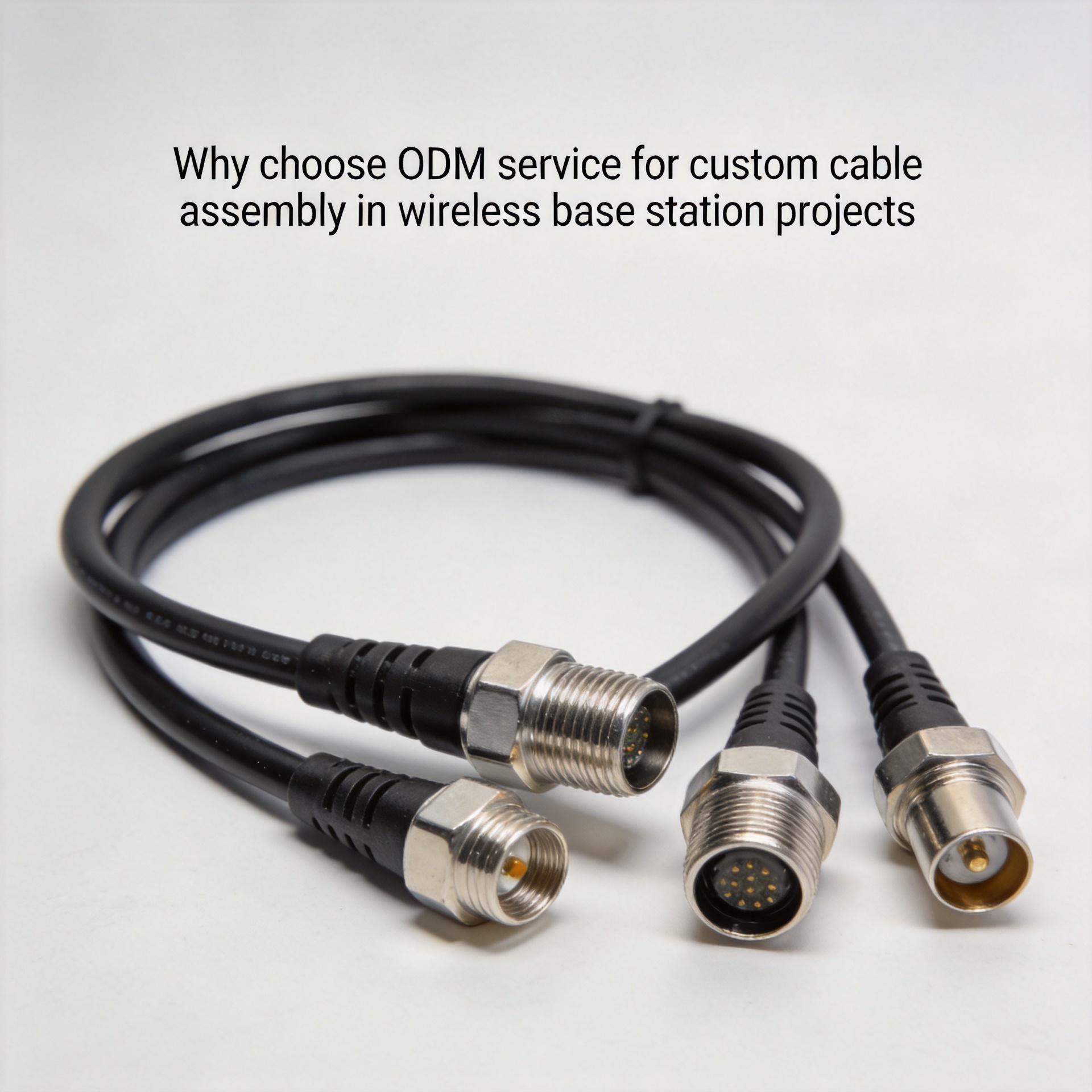
Collaborating with an experienced manufacturing partner like WORLDPEAK for original design manufacturing ensures that every wiring harness, RF jumper, and fiber-optic link is architected from the ground up to match exact base station spatial and electrical constraints.
The Engineering Complexities of Wireless Base Station Interconnects
Base station hardware operates in some of the most punishing physical environments on Earth, ranging from scorching desert rooftop installations to freezing mountain-top communication towers. Internal and external cabling must maintain absolute mechanical integrity and electrical stability under severe stress factors. When engineering inter-unit cabling for remote radio units (RRUs), baseband units (BBUs), and tower-mounted amplifiers (TMAs), standard off-the-shelf components frequently introduce points of vulnerability that compromise network uptime.
Utilizing an advanced ODM service allows base station equipment manufacturers to address these complexities directly through customized engineering:
-
Thermal and UV Endurance: Specially formulated cross-linked polyolefin or halogen-free outer jackets that resist extreme thermal cycling and solar ultraviolet degradation over decades of continuous outdoor exposure.
-
Vibration and Wind Load Resistance: Ruggedized strain-relief boots, heavy-duty backshell designs, and secure mounting mechanisms that prevent micro-fractures caused by constant high-wind tower sway.
-
Interference Mitigation: Multi-layered braided and foil shielding that prevents passive intermodulation (PIM) and electromagnetic interference across congested cellular spectrums.
-
Hermetic Sealing and Moisture Protection: Advanced adhesive-lined heat shrink tubing and O-ring seals that prevent moisture ingress in coastal or high-humidity operational regions.
OEM vs. ODM: Why Original Design Manufacturing Drives Base Station Innovation
Procurement teams often debate whether an Original Equipment Manufacturer (OEM) or Original Design Manufacturing (ODM) model best suits their product development pipeline. While OEM manufacturing builds strictly to customer-provided blueprints, an ODM service encompasses full turnkey capabilities—from initial conceptual design, electrical simulation, and prototyping to mass production and comprehensive compliance testing.
For wireless base station projects, this holistic approach eliminates costly redesign cycles. WORLDPEAK leverages its deep domain expertise in radio frequency engineering to optimize cable routing, select ideal dielectric materials, and fine-tune connector impedances before a single prototype is fabricated. This collaborative design partnership significantly reduces overall project risk and compresses development timelines.
Parameter Comparison: OEM vs. ODM Cable Procurement Models
To illustrate the distinct advantages of partnering with an experienced provider for base station infrastructure, the following table compares standard OEM procurement with a comprehensive ODM service model across key operational dimensions:
| Evaluation Dimension | Standard OEM Manufacturing Model | WORLDPEAK ODM Service Model |
| Design Responsibility | Fully dependent on customer's internal engineering team. | Collaborative joint design, simulation, and DFM optimization. |
| Prototyping Speed | Slower iterations due to frequent specification discrepancies. | Rapid prototyping backed by in-house tooling and 3D modeling. |
| Cost Efficiency | Higher risk of material over-specification and assembly bottlenecks. | Optimized Bill of Materials (BOM) and streamlined automated production. |
| Quality & Compliance | Basic factory continuity checking. | Rigorous VNA testing, PIM verification, and ISO-aligned quality audits. |
Rigorous Factory Quality Control and Compliance Standards
Telecommunications infrastructure components must adhere to strict international standards to guarantee network safety and uninterrupted operational uptime. A failure in a single feeder cable or base station jumper can trigger widespread network outages and costly carrier penalties.
WORLDPEAK enforces a multi-tiered quality assurance workflow for every custom cable assembly produced under our ODM service:
-
Vector Network Analyzer (VNA) Verification: Every assembly is swept across its target frequency spectrum to confirm optimal return loss, insertion loss, and low VSWR.
-
Passive Intermodulation (PIM) Testing: Critical for multi-carrier base station systems, PIM testing ensures that internal connector joints do not generate spurious signals that degrade receiver sensitivity.
-
Environmental Stress Screening: Samples undergo salt spray corrosion resistance testing, water ingress hermeticity checks, and mechanical pull-force verification.
By integrating these stringent testing protocols directly into the production workflow, WORLDPEAK ensures that communication manufacturers receive fully certified, field-ready hardware.
Integrating Custom Interconnects Into Your Supply Chain Strategy
Adopting an integrated ODM service for your upcoming wireless base station projects streamlines inventory management and reduces supplier overhead. Instead of coordinating disparate suppliers for connectors, coaxial cables, and labeling materials, partnering with WORLDPEAK consolidates your entire interconnect supply chain under one roof.
To explore our full engineering capabilities, technical data sheets, and custom development options for telecommunications infrastructure, visit our main